

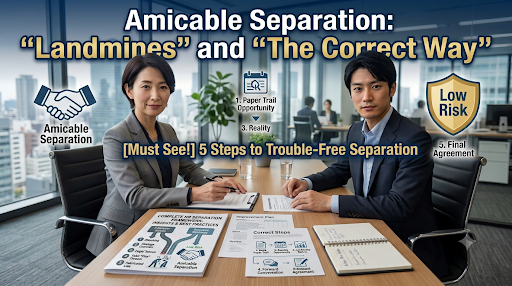
 Hello, fellow business owners and HR professionals. Dealing with a toxic or severely underperforming employee can be an absolute nightmare. When someone constantly disrupts team harmony or fails to improve despite multiple warnings, it drags down everyone’s morale. It’s only natural to want to initiate “the talk” and suggest that it might be time to part ways.
Legally speaking, you have every right to approach an employee and negotiate a mutual separation (commonly known as a voluntary resignation request).
However, one wrong move can completely backfire. If you cross the line, the employee could sue the company for “constructive dismissal” or “infliction of emotional distress.” In worst-case scenarios, companies are forced to reinstate the employee and pay millions of yen in back pay.
To keep you out of legal hot water, here are 5 dangerous “landmine approaches” you must avoid at all costs, along with the right steps to resolve the issue safely.
The 5 “Landmine Approaches” That Can Ruin Your Company
When emotions run high, a single slip of the tongue can become permanent evidence against you in court. Never use these five approaches:
1. Attacking Their Character (Insults & Verbal Abuse)
What to avoid: With your lack of skills, you won’t survive anywhere else,” “You’re a parasite to this company,” or “You’re worse than a fresh graduate.
The Risk: No matter how poor the employee’s performance is, attacking their character constitutes workplace harassment (power harassment). Courts regularly order employers to pay heavy damages just for slamming desks or using insulting language during these meetings.
2. Holding Them Hostage Until They Agree (Coercion)
What to avoid: “Be a man and take responsibility,” or “You are not leaving this room until you sign this resignation letter.”
The Risk: Pressuring someone who has clearly stated they don’t want to leave is no longer a negotiation—it is coercion. Any resignation letter signed under duress can easily be overturned and declared null and void later on.
3. Touching Legal Taboos (Harassment & Discrimination)
What to avoid: “Taking maternity/parental leave causes trouble for the team, so it’s better for you to step down.”
The Risk: Even if the employee has other legitimate performance issues, linking a termination request to pregnancy, childbirth, childcare, or nursing care violates labor laws instantly. It immediately paints the company as the “bad guy” and ruins your legal standing.
4. Bluffing with a Fake “Fire” Threat (Bluffing)
What to avoid: “If you don’t resign voluntarily, we will fire you for cause (disciplinary dismissal). Resigning now is better for your resume.”
The Risk: This is the most dangerous trap of all. If you bluff about firing them without objective, legally justifiable grounds, the employee can later sue, claiming: “I was intimidated into signing the resignation.” In past precedents, courts have ruled such dismissals invalid and ordered employers to pay massive sums (sometimes exceeding 10 million yen) in back pay for the entire period the employee was out of work.
5. Lying to Get Out of a Tight Spot (Fabrication)
What to avoid: “Actually, we’ve decided to close down this specific branch/department soon.”
The Risk: Lying about a company closure just to get an employee to give up and leave is an automatic foul. If the company keeps operating normally afterward, the separation agreement becomes void because it was built on a lie.
How to Achieve an Amicable Separation (Without the Drama)
At this point, you might be thinking, “So, my hands are tied? I can’t say anything?!” Don’t worry. You can minimize your legal risks and resolve this smoothly by focusing on one key concept: aligning the employee’s self-assessment with reality. Ninety percent of these disputes happen because there is a massive gap between how the company views the employee and how they view themselves. Most problematic employees genuinely believe, “I’m doing a great job; it’s the company that’s wrong.” If you tell them to leave out of nowhere, they will naturally resist.
Here is the correct, risk-free step-by-step process:
Step 1. Build a Paper Trail based on Facts
Don’t just give verbal warnings. Keep written records of every mistake, missed deadline, and follow-up coaching session via email, daily reports, or memos.
Step 2. Provide a Clear Opportunity & Deadline for Improvement
Set a specific goal, such as: “We need you to be able to handle this specific task at this standard by [Date].”
Step 3. Let Reality Sink In
If they fail to meet the goals by the deadline, present the objective data to them. This is when the employee finally realizes, “Maybe this environment isn’t the right fit for me.”
Step 4. Have a Forward-Looking Conversation
Calmly initiate the discussion from a constructive angle: “For the sake of your career and our business, wouldn’t it be better to look for a better match?”
Conclusion: Slow and Steady Wins the Legal Race
 It is completely understandable to want a quick fix when you’re frustrated. However, in today’s world where labor laws heavily protect employees, letting your emotions drive the conversation is corporate suicide.
The key to protecting your business is staying calm, documenting everything, and creating a structured process where the employee eventually accepts reality.
Note:If your situation feels overly complicated, remember: consulting an employment lawyer or HR expert before you say a word is always the safest and most cost-effective route!