

For foreign nationals living in Japan and companies employing foreign talent, the landscape surrounding visas (Status of Residence) is reaching a major turning point.
In particular, following reports in late July 2026 regarding the Immigration Services Agency’s (ISA) plan for a major overhaul of the Permanent Residency (PR) screening guidelines, a wave of stricter evaluations is spreading across all status of residence categories.
This article provides a clear breakdown of the basic visa structures, the newly announced PR tightening measures, and practical steps you can take to prevent application denials.
1. Basic Structure of Japan’s Status of Residence (Visa) System
Japan’s Status of Residence is broadly divided into two categories: “Activity-based” and “Status/Family-based.” Understanding which category you belong to is the foundation of everything.
| Category | Representative Visas | Restrictions on Work/ Activities | Key points to Note |
| Activity-based | Student, Engineer/ Specialists in Humanities/ International Services, Specified Skilled Worker, etc. | Restricted(Only permitted activities allowed) | Student part-time jobs require a “permit to Engage in Activity Other than That Permitted” (Up to 28 hours/week). |
| Status/ Family-based | Spouse of Japanese National, Permanent Resident, etc. | None (Generally unrestricted) | The authenticity of family/ marital relationships is strictly evaluated. |
Important Premise
A Status of Residence is not an inherent “right” for foreign nationals, but a “permission” granted by the Japanese government. Violating the rules can lead to visa extension denials or revocation.
2. [Announced July 2026] Major Overhaul of Permanent Residency (PR) Guidelines
The new operational guidelines for Permanent Residency screening revealed in July 2026 introduce much clearer and stricter criteria than before.
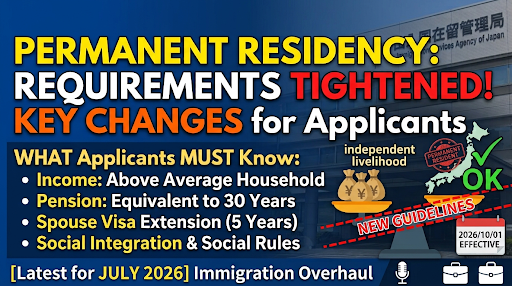
① Clarification of Income Standards (Above Average Japanese Household Income)
Key Change: The previous informal benchmark (approx. 3.0 to 3.5 million yen/year) will be raised to “equal to or higher than the average Japanese household income.”
Dependents Considered: The required income threshold increases depending on the number of dependents, including family members living overseas.
Exclusion of Part-Time Income: Income from part-time work under the “Permit to Engage in Activity Other than That Permitted” (e.g., dependents on a “Dependent” visa) will generally be excluded when calculating combined household income.
② Future Expected Pension Benefits (Equivalent to 30 Years of Employees’ Pension)
Key Change: Applicants will be expected to have an estimated future pension payout “equivalent to having contributed to the Employees’ Pension (Kousei Nenkin) for 30 years.” Any shortfall must be offset by proof of sufficient financial assets (such as savings).
③ Extension of Application Criteria for Spouse Visas
Key Change: The previous exception for spouses of Japanese nationals or permanent residents (3 years of marriage & 1 year of residence) is expected to be extended to “5 years of marriage & 3 years of residence in Japan.”
④ Assessment of Social Integration and Obligation Compliance
Screening will strictly evaluate whether applicants fulfill Japanese social rules, including Japanese language proficiency for daily life, integration into local customs, and compliance with compulsory education obligations for their children.
⑤[Note] Permanent Residency Application with a “3-Year Visa” Starting April 2027
Starting April 1, 2027, the rules for Permanent Residency (PR) applications will change, and as a general rule, a “5-year” status of residence (the maximum period) will be required.
However, as a transitional measure, individuals who already hold a “3-year” status of residence as of March 31, 2027, will still be eligible to apply within the validity period of that card, strictly limited to their first application under that status.
[Eligibility Check]
Eligible: Applying for the first time using a “3-year visa” granted on or before March 31, 2027, within its validity period.
Not Eligible: Holding a “3-year visa” renewed and newly issued on or after April 1, 2027 (you cannot apply until you obtain a “5-year visa”).
Even if you qualify under the transitional measure, you will only get one chance. Therefore, please prepare your application documents with great care.
3. Two Key Screening Points That Make or Break Applications in Practice
In real-world practice, the following two areas are where visa renewals and PR applications most frequently run into trouble:
① Strict Compliance with Tax & Social Insurance Payout Deadlines
Simply having “paid” is not enough. Immigration authorities focus heavily on “whether payments were made on time before the due date” and “whether you have receipt proofs or payment certificates saved as objective evidence.” Setting up automatic bank transfers is highly recommended to avoid accidental delays.
② Consistency Between Job Duties and Language Proficiency
For work visas (such as “Engineer / Specialist in Humanities / International Services”), actual day-to-day duties must closely align with the granted status. Furthermore, for roles involving translation/interpretation or direct customer service, proof of actual Japanese proficiency (e.g., JLPT N2 or higher, or graduation from a Japanese university/vocational school) is being evaluated with increasing strictness.
4. Practical Timeline and Action Steps
The new Permanent Residency screening standards are expected to be rolled out in phases. Prospective applicants should act promptly.
[Key Timeline Schedule]
**From October 1, 2026**New income and household criteria take effect.
**from April 1, 2027** Pension standards, spouse exception extensions, and other criteria take effect in phases.
Action Steps for Prospective Applicants Right Now
1. Evaluate Application Timing: If you meet current requirements, consider applying before September 2026 (before the new guidelines take effect).
2. Review Income and Dependents: Check overseas dependent declarations and calculate whether the main applicant’s standalone income meets the new threshold.
3. Gather Pension and Asset Proof: Check your contribution history via “Nenkin Net” and organize documentation for savings and financial assets.
5. Conclusion: Mutual Understanding Builds a Harmonious Society
This trend toward stricter enforcement impacts not only foreign residents but also employers hiring foreign talent and local communities as a whole.
Employers must support their international staff by helping them understand visa regulations and social insurance procedures rather than leaving it as a personal responsibility. Likewise, foreign residents who fulfill tax/insurance obligations and abide by permitted activity limits will find the clearest path toward a stable life and future Permanent Residency in Japan.
※ Disclaimer & Important Notice
This article was created based on media reports and publicly available information as of July 2026. Because actual screening guidelines and implementation timelines are subject to change, please always consult the official announcements by the Immigration Services Agency (ISA) or seek advice from a certified Administrative Scrivener (Gyoseishoshi) for final verification.