

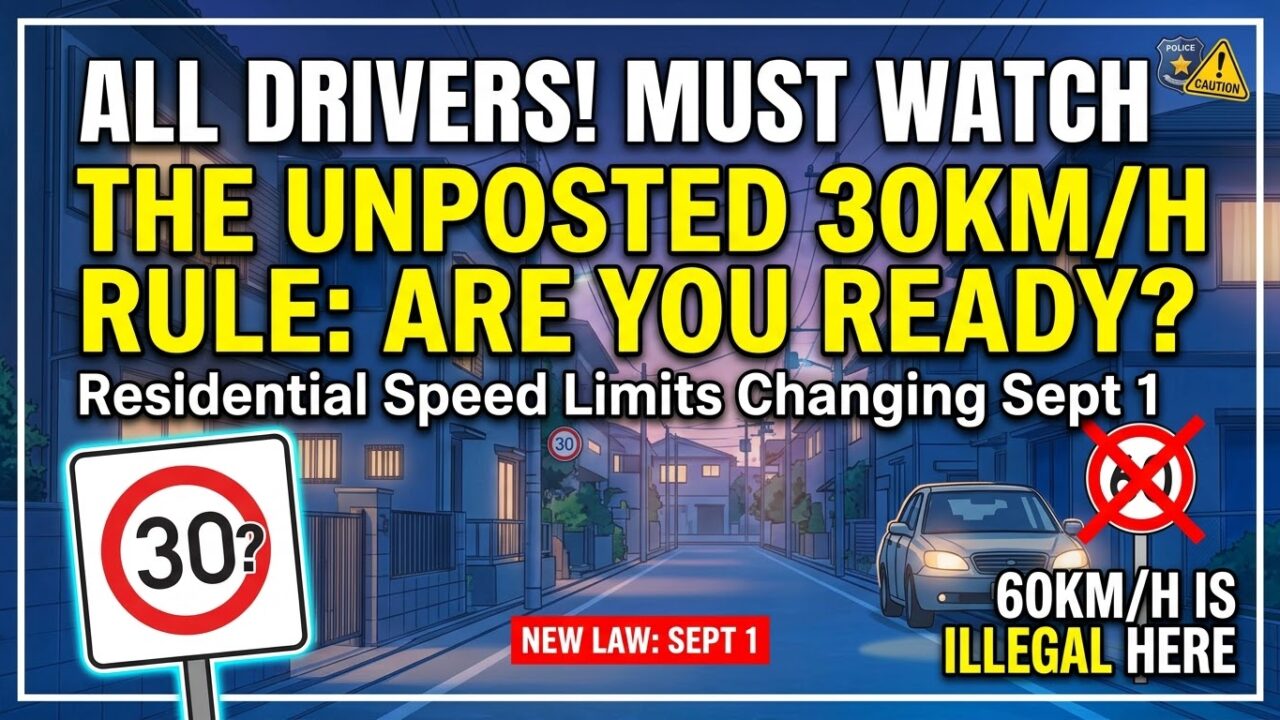
Thank you for your hard work driving every day!
Drivers, are you aware of the amendment to the road traffic laws taking effect on September 1, 2026?
This is a key traffic rule change that every driver needs to know.
Here is a clear breakdown of what you need to keep in mind!
What Changes with This Law Amendment?
The key change is the lowering of the statutory speed limit on residential roads.
Previously, on general roads where no speed limit was specified by signs, the statutory speed limit was 60 km/h by default.
However, starting September 1, 2026, the statutory speed limit on residential roads without centerlines will be 30 km/h—even if there are no speed limit signs posted!
Which Roads Will Change to 30 km/h?
Roads changing to 30 km/h: Relatively narrow roads without centerlines or marked traffic lanes, such as those in residential areas.
Roads remaining at 60 km/h: General roads with centerlines or marked traffic lanes, roads separated by median strips, and motorways/expressways.
Key Point
If a speed limit is posted on a sign (e.g., “40 km/h”), the posted speed limit takes priority over the default statutory speed limit (30 km/h).
How Does This Differ from “Zone 30”?
You may have seen “Zone 30” signs around town before.
Zone 30: An initiative that designates an entire designated zone to limit speeds to 30 km/h.
Zone 30 Plus: In addition to the 30 km/h speed limit, physical modifications like road humps are implemented to naturally discourage speeding.
This legal amendment is not simply about adding more “Zone 30” areas. Rather, it is a fundamental rule overhaul where the statutory speed limit itself for all qualifying residential roads will uniformly become 30 km/h!
Why Is It Necessary to Lower the Speed to 30 km/h?
Looking at the relationship between vehicle speed and pedestrian fatality rates in traffic accidents makes the reason clear:
20 km/h to 30 km/h: Fatality rate 0.9%
30 km/h to 40 km/h: Fatality rate 3.0%
40 km/h to 50 km/h: Fatality rate 8.4%
50 km/h to 60 km/h: Fatality rate 17.0%
As shown by the data, the fatality rate for pedestrians spikes rapidly once speeds exceed 30 km/h. Because residential roads bring vehicles and pedestrians into close proximity, setting the limit to 30 km/h is critical for minimizing casualties in the event of an accident.
What Happens If You Unknowingly Drive at Your Usual Speed? (Penalties and Points)
If you drive on a newly 30 km/h restricted residential road with your usual driving habits, here are the consequences:
Driving at 40 km/h (10 km/h over): 1 penalty point / 9,000 yen fine
Driving at 50 km/h (20 km/h over): 2 penalty points / 15,000 yen fine
Driving at 55 km/h (25 km/h over): 3 penalty points / 18,000 yen fine
Up to this level, it is handled via standard blue traffic tickets (infraction fines).
However…!
Driving at 60 km/h (30 km/h over): 6 penalty points (Immediate license suspension threshold) + “Red Ticket” (Criminal proceedings)
If you drive at 60 km/h based on past habits, it will result in a red ticket and an immediate 30-day driver’s license suspension (for drivers with no prior administrative record)!
*Note: If 6 points are incurred in a single violation, you are ineligible for the “offender training course” that would otherwise allow you to avoid suspension.
Summary
Starting September 1, 2026, when driving on narrow streets in residential areas, it is essential to remember: “30 km/h speed limit, even without signs.”
Beyond obeying the law, let’s keep our speeds down on residential roads to ensure everyone’s safety!